
Dr. Jessica Dimmick, Au.D
August 30, 2026

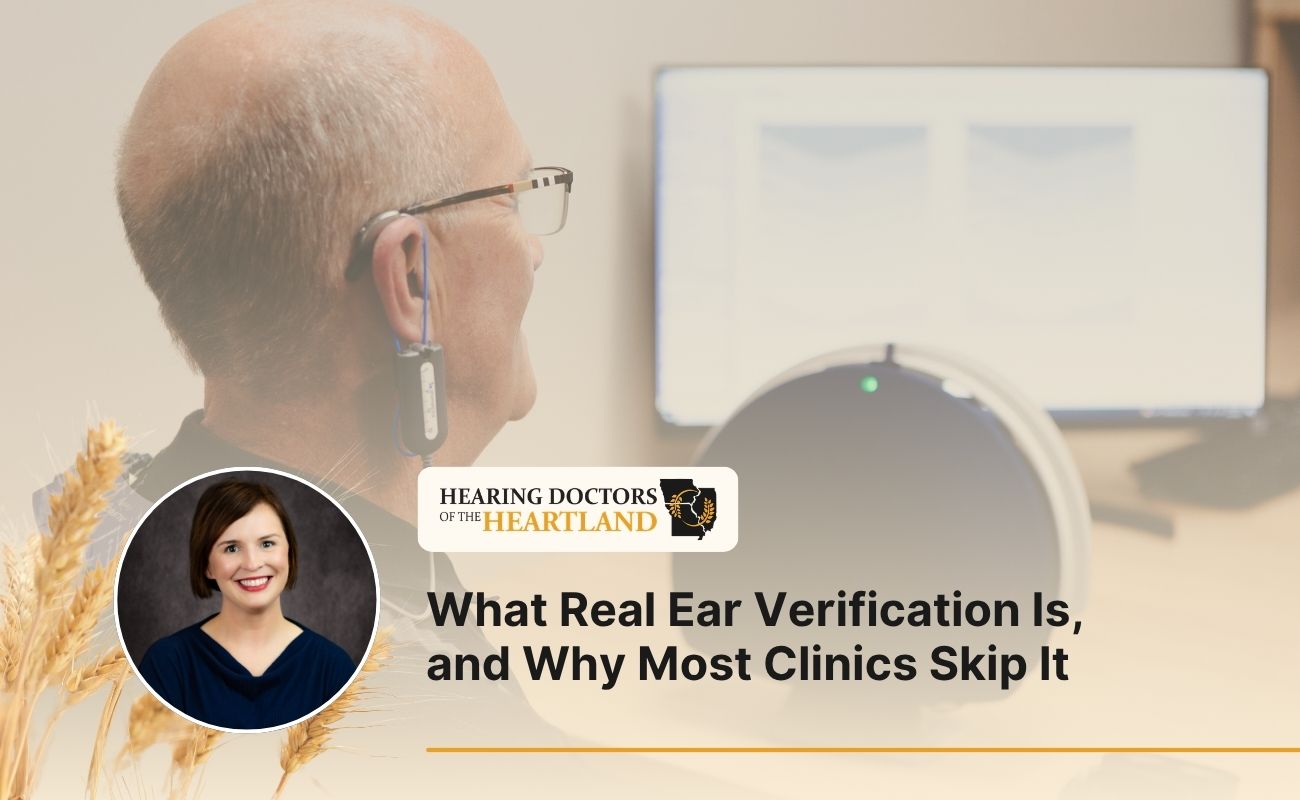
You just spent a few thousand dollars on new hearing aids. The provider ran through the setup on a computer screen, sent you home, and told you to come back if anything felt off. Here's a question worth asking before that happens: how do they actually know the devices are working the way your ears specifically need them to?
That's what real ear verification answers. And it's an important hearing aid fitting step a surprising number of practices leave out entirely.
Real ear verification, also called real ear measurement, is a test performed with a thin probe microphone placed just inside your ear canal, alongside the hearing aid itself. While you wear the device, the equipment measures the actual sound reaching your eardrum at different pitches and volumes. Not an estimate. Not a manufacturer's average. The real, measured output in your specific ear.
Manufacturer software makes its own predictions based on your audiogram, and it's a reasonable starting point. But ear canal shape varies a lot from person to person, and that shape changes how sound behaves once it enters the canal. Two people with identical hearing loss can need noticeably different settings just because of how their ears are built. Software alone can't account for that. A probe microphone can.
Here's the part that surprises most patients: research going back over a decade, most recently discussed at an American Academy of Audiology conference, has suggested that only around 30 percent of practices that dispense hearing aids perform real ear verification on a regular basis.
That number has been repeated at conferences for years without much movement, and it likely varies by region and practice type. Still, even taking it loosely, it tells you something. This isn't a niche or optional add-on. It's a widely recognized best practice, and a lot of clinics don't do it.
Why? Partly equipment cost. Partly time, since verification adds a few minutes to a fitting appointment. And partly, it's just easier to trust the first-fit software and move on. None of those are good reasons for skipping a step that directly affects whether hearing aids are properly programmed for a person.
Without verification, a hearing aid might be under-amplifying soft speech sounds, the "s" and "f" and "th" sounds that carry a lot of meaning in conversation, while over-amplifying something else entirely. You might notice sounds feel harsh in one ear or muffled in the other. Or you might not notice anything specific, just a nagging sense that the devices aren't quite delivering what you were promised. That gap between what a hearing aid should be doing and what it's actually doing at your eardrum is exactly what real ear verification is built to close.
It's also not a one-time test. As your hearing changes, or as a device ages, re-verification helps confirm the fitting still matches your needs.
Our team performs real ear verification as a standard part of hearing aid fittings, not something offered only if you ask for it. We measure the sound at your eardrum, compare it against the target based on your hearing loss, and adjust the device until the numbers, and your feedback, line up. It adds a bit of time to your appointment. We think that's worth it.
If you're in Macomb, or out in the McDonough, Henderson, or Hancock County area, and you're wondering whether your current hearing aids are actually programmed the way they should be, we'd be glad to take a look. At Hearing Doctors of Illinois, real ear verification isn't a special request. It's simply how we fit hearing aids, because a device that isn't measured is a device you're guessing about.
Give us a call at (309) 421-0819 to schedule an evaluation or a fitting check at our Macomb location. We'll walk you through exactly what we measure and why it matters for your hearing.